Visual Details of Frontline Reality Invisible in Black-and-White Photographs - The Lens of History
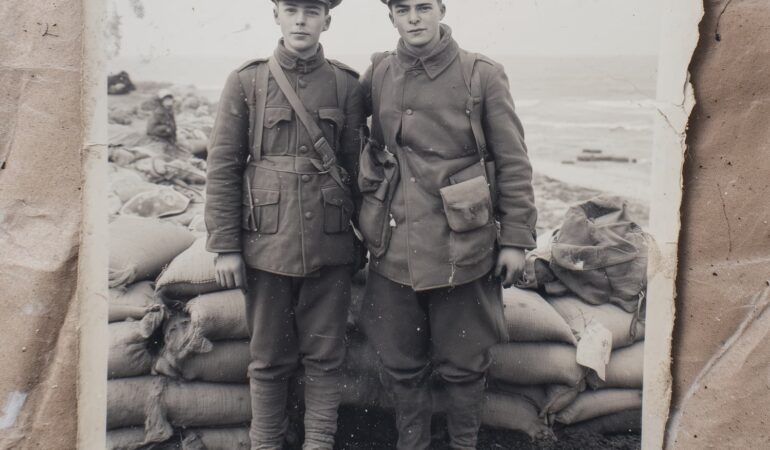
Black-and-white photographs have long defined how we imagine the First World War. They shape our perception of trenches, soldiers, ruined landscapes, and distant battlefields. The monochrome aesthetic has become inseparable from the era itself, lending the images an aura of historical distance and solemnity. Yet this very absence of color conceals an entire layer of reality. Many visual details of frontline life—textures, contrasts, emotional cues, and environmental conditions—remain difficult or even impossible to perceive in black-and-white imagery.
Colorized photographs, despite debates about their interpretive nature, reveal aspects of the war that traditional images often obscure. They do not change history, but they change visibility. They invite the viewer to notice what was always there, yet visually muted by technological limitations.
The Camouflage of the Natural World
One of the most striking differences introduced by color lies in the representation of terrain. In black-and-white images, mud, earth, uniforms, wooden structures, and smoke frequently collapse into similar shades of gray. The battlefield appears flattened, its elements visually blending together. Trenches seem carved from a uniform, abstract landscape.
Color restores differentiation. Mud reveals itself not as a neutral surface but as a spectrum of browns, ochres, and damp grays. Vegetation, even when sparse or damaged, introduces unexpected greens. Wooden beams display variations in tone, age, and decay. The environment becomes materially specific rather than visually generic.
This differentiation deepens our understanding of camouflage—not merely as military technique but as lived experience. Soldiers were embedded in environments whose colors shaped visibility, concealment, and perception in ways that monochrome images cannot fully convey.
Uniforms and the Language of Identity
Military uniforms, central to visual representations of war, also acquire new meaning in color. Black-and-white photographs reduce fabric distinctions, making different units and national forces appear more visually uniform than they actually were. Subtle variations in cloth, insignia, and wear patterns often vanish.
Color reveals complexity. Khaki, field gray, horizon blue, and other historically accurate shades reintroduce distinctions among armies. Differences in material quality, fading, stains, and repairs become perceptible. A uniform is no longer a symbolic marker of “soldierhood” alone but an object shaped by use, environment, and supply conditions.
These details illuminate the social dimension of military life. Uniforms encode hierarchy, logistics, and national identity. Their colors carry institutional meaning that black-and-white imagery inevitably dilutes.
Skin Tones and Human Presence
Perhaps the most profound transformation introduced by color concerns the human face. Monochrome photographs often render skin as a pale or dark gray surface, abstracting individuality. Faces appear distant, sometimes ghostly, their emotional expression subdued by tonal uniformity.
Color rehumanizes. Variations in complexion, fatigue, exposure, and health become visible. The flushed cheeks of cold-weather exposure, the sallow tones of illness, the dirt embedded in skin—all contribute to a sense of physical presence. The soldier becomes less an icon and more a person inhabiting a body under strain.
This shift is not merely aesthetic. It alters empathy. Color reduces psychological distance, confronting the viewer with the immediacy of lived experience.
The Materiality of Damage and Decay
Destruction is a constant motif in wartime photography. Ruined buildings, shattered trees, and fractured landscapes dominate visual archives. In black-and-white, however, structural damage can appear abstract. Textures flatten, and materials merge into uniform gray masses.
Color restores material specificity. Brick, stone, wood, metal, and soil differentiate themselves. Burn marks, rust, splintered surfaces, and exposed interiors become more legible. The viewer perceives not only that destruction occurred, but how it manifested physically.
Such details enrich historical interpretation. War damage is not a singular condition but a complex interaction of forces, materials, and time. Color highlights these interactions with greater clarity.
Weather and Environmental Conditions
Frontline reality was inseparable from weather. Rain, snow, fog, and seasonal transitions shaped daily existence. Yet black-and-white photography often struggles to convey atmospheric nuance. Moisture, temperature, and light conditions may be implied but rarely felt.
Color enhances atmospheric perception. Dampness becomes visible through darkened fabrics and reflective surfaces. The coldness of winter scenes contrasts with muted summer palettes. Smoke, clouds, and sky tones acquire depth and variation. Environmental conditions emerge as active agents rather than passive backdrops.
These visual cues remind us that soldiers lived not only in conflict zones but in environments whose sensory qualities influenced morale, movement, and survival.
Small Objects and Everyday Life
Wartime photography frequently captures mundane objects: tools, letters, equipment, personal belongings. In monochrome images, these items may recede into the visual background, their significance overlooked amid larger compositional elements.
Color draws attention to the ordinary. Metal surfaces reflect light differently from cloth or wood. Paper, leather, and glass display distinct tonal qualities. Even minor objects gain visual weight, inviting closer examination.
Through such details, the viewer encounters the everyday dimensions of war—routine, maintenance, adaptation. The battlefield is revealed not solely as a site of combat but as a space of daily human activity.
Perception, Memory, and Visual Interpretation
The invisibility of certain details in black-and-white photographs is not a failure of the medium but a consequence of its constraints. Monochrome imagery abstracts reality, emphasizing form, contrast, and composition over material differentiation. It constructs a particular visual language of history.
Colorized photographs introduce an alternative mode of seeing. They amplify distinctions, highlight textures, and reduce interpretive distance. However, they also raise questions about authenticity, reconstruction, and historical mediation.
Yet regardless of methodological debates, color underscores a fundamental truth: visual perception is never neutral. The way we see history is shaped by the technologies through which it is presented.
Conclusion
Black-and-white photographs remain invaluable historical documents, preserving moments that might otherwise have vanished. Their aesthetic has become entwined with cultural memory of the First World War. Nevertheless, the absence of color inevitably conceals layers of visual information.
Colorized images, when approached critically, reveal details long obscured—environmental contrasts, material textures, human presence, and subtle markers of lived experience. They do not alter the past but expand its perceptibility.
By attending to these visual details, we gain a richer understanding of frontline reality. History, after all, is not only what happened, but what can be seen.